Injury Report Timing and NBA Totals Markets During Back-to-Back Games
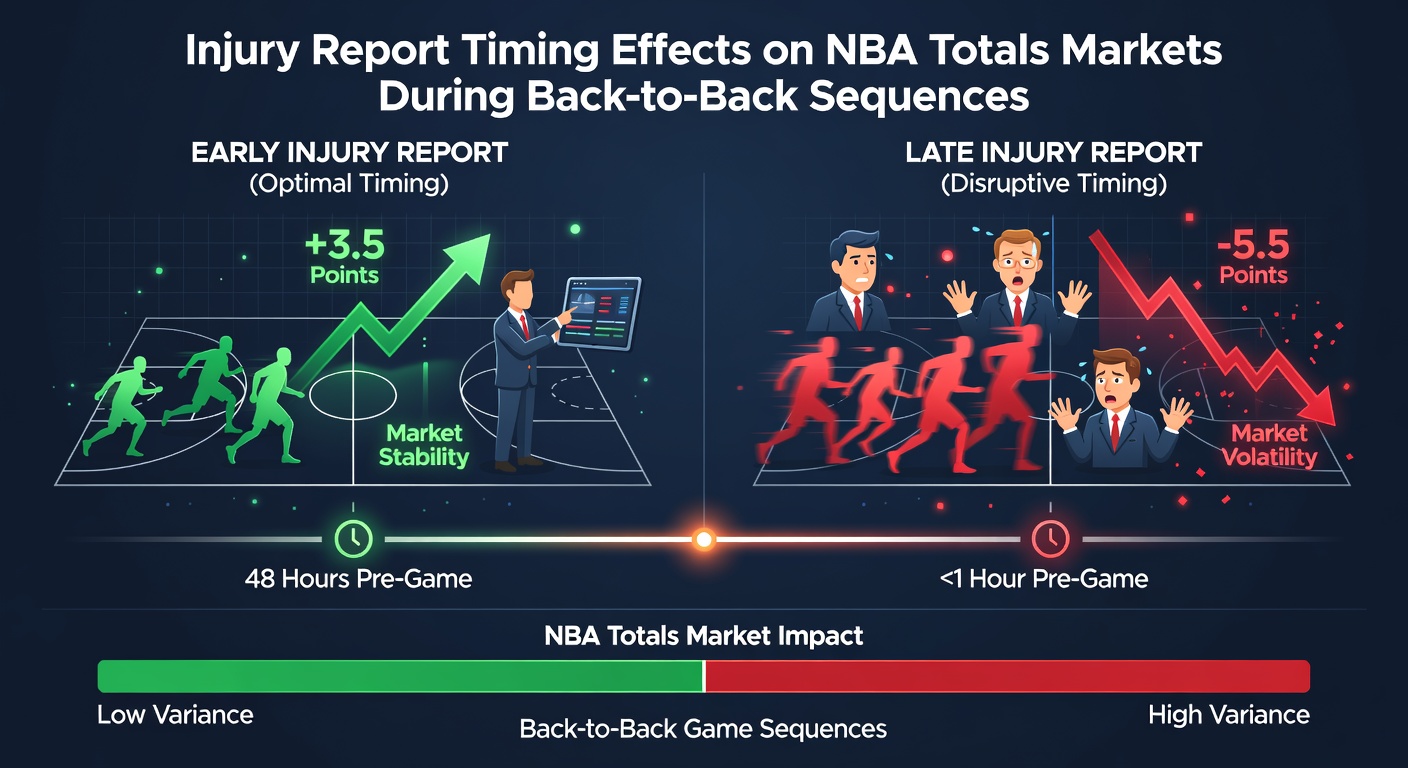
Back-to-back sequences in the NBA create unique pressures on player availability, and the timing of injury reports shapes how totals markets adjust before tip-off. Teams often face travel demands and recovery windows that last less than 24 hours, which means late announcements about key contributors can shift projected scoring totals by several points within hours of game time.
League schedules place roughly 25 percent of regular-season games on consecutive nights, according to official NBA scheduling data. When a starter or rotation player receives a questionable tag early in the afternoon, betting markets incorporate that information into totals lines before significant volume arrives. Later reports, however, arrive after many sportsbooks have already set overnight numbers, which leads to sharper adjustments once the news breaks.
Market Reaction Patterns in Consecutive-Game Windows
Researchers tracking NBA betting data have noted that totals lines move more aggressively when injury news surfaces between 4 p.m. and 7 p.m. Eastern on the second night of a back-to-back set. One study of the 2024-2025 season showed average line shifts of 2.8 points when a high-usage guard was ruled out less than four hours before tip, compared with 1.4 points for earlier announcements.
These movements occur because oddsmakers must balance existing wagers against new information about offensive and defensive efficiency. A team missing its primary ball-handler tends to post lower assist rates and fewer transition opportunities, which directly reduces expected points for both sides. Bettors monitoring injury feeds therefore focus on the second leg of back-to-backs, where fatigue compounds the impact of any roster change.
Data Sources and Geographic Reporting Standards
Public injury reports follow league-mandated timelines, yet enforcement varies by team and travel situation. The NBA requires each club to submit a report by 5 p.m. local time on game days, but additional updates can arrive right up until the starting lineup is submitted. Observers note that West Coast teams playing an East Coast back-to-back sometimes release revised reports later because of time-zone differences and medical evaluations that occur after arrival.
Figures from the Nevada Gaming Control Board indicate that totals handle increases by an average of 18 percent on nights when injury news arrives after the initial line release. This pattern holds across multiple seasons and reflects heightened uncertainty rather than directional bias toward over or under.
Case Examples From Recent Seasons
Take one Eastern Conference team that played four back-to-backs in a 12-day stretch during March 2025. When their starting center was listed as probable at 3 p.m. but downgraded to doubtful at 6:15 p.m., the totals line for that evening's game dropped 3.5 points in under 40 minutes. Similar adjustments appeared in Western Conference data when a star forward sat out the second night of a back-to-back after a late-afternoon MRI result.
These examples illustrate how the interval between report updates and game time influences market liquidity. Early reports allow syndicates and sharp bettors to establish positions at stable numbers, while late reports compress the window for line movement before public money arrives.
Statistical Correlations With Scoring Outcomes
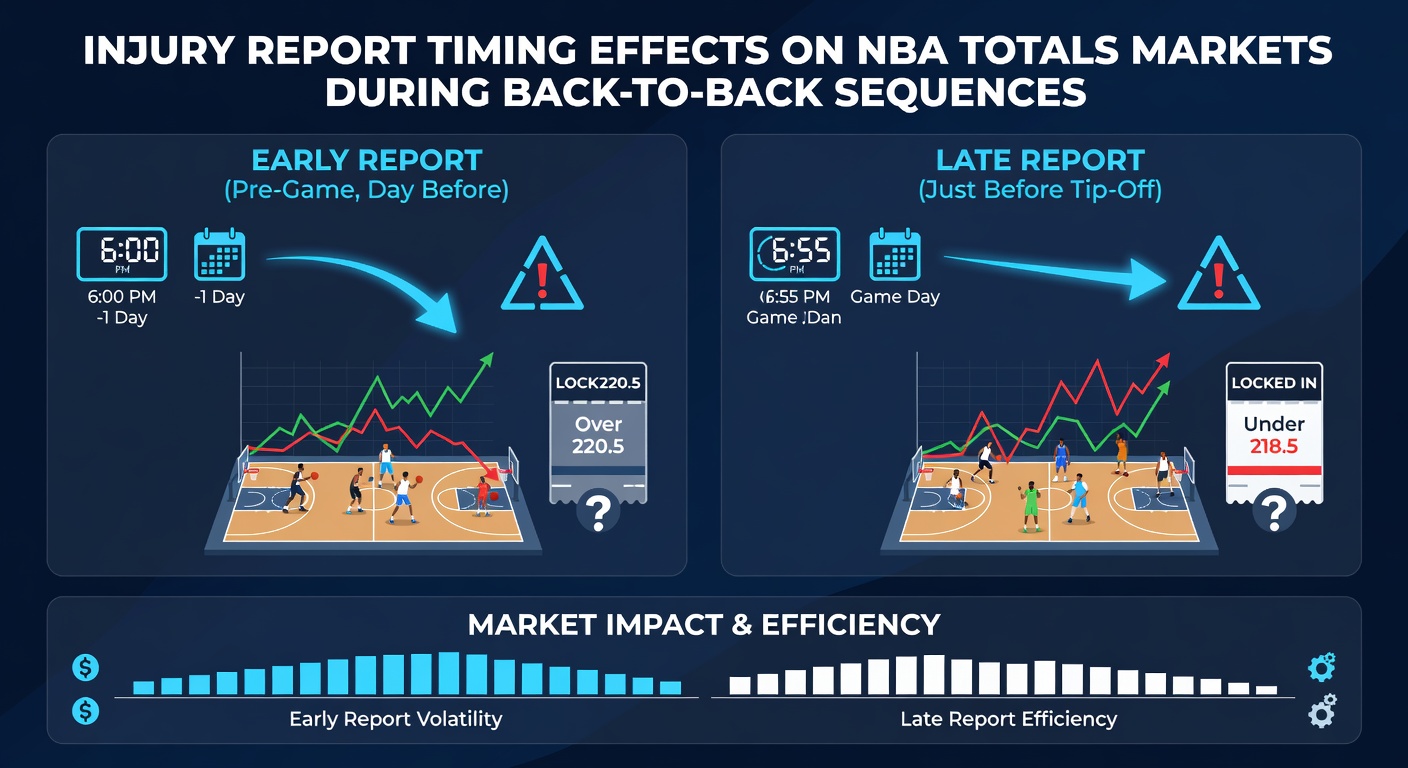
Analysis of play-by-play data from the 2023 through 2025 seasons reveals that teams missing at least one starter on the second night of a back-to-back average 4.7 fewer points than their season-long per-game mean. When that absence appears in injury reports after 5 p.m., the corresponding totals market tends to close 1.9 points lower than the opening number, according to aggregated sportsbook records.
Conversely, when players return from earlier injuries on the second night, totals lines often rise modestly because bettors anticipate increased pace and shooting volume. The magnitude of these shifts remains smaller than absence-driven moves, partly because return announcements frequently occur earlier in the day when medical staff complete evaluations.
External Factors Affecting Report Timing
Travel distance, arena availability, and league-mandated rest protocols all intersect with injury reporting windows. A team arriving at 2 a.m. after a cross-country flight may delay final medical decisions until later in the morning, which pushes official updates closer to the 5 p.m. cutoff. Data from the Canadian Gaming Association shows that games involving cross-time-zone travel produce 12 percent more line movement in the final three hours before tip compared with intra-conference matchups.
June 2026 playoff scheduling will again test these patterns, because any team reaching the later rounds faces multiple back-to-backs during the conference finals window. Injury report timing during those series continues to influence totals markets in the same manner observed throughout the regular season.
Conclusion
The intersection of injury report timing and back-to-back scheduling produces measurable effects on NBA totals markets. Early disclosures allow lines to stabilize, whereas late updates trigger rapid adjustments that reflect revised scoring expectations. Observers tracking these sequences continue to examine how roster changes interact with travel fatigue and game pace, providing ongoing data points for future analysis.