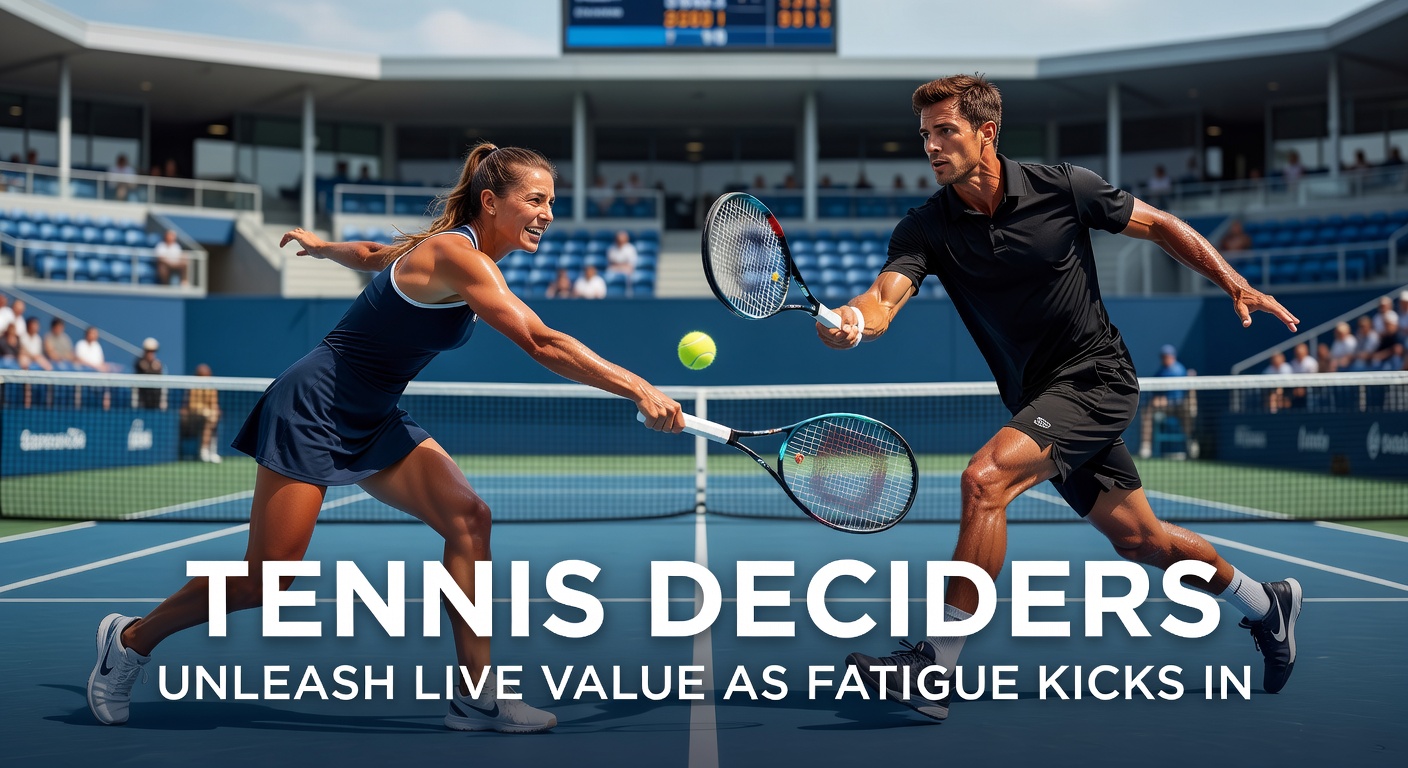
Tennis Deciders Unleash Live Value as Fatigue Kicks In
Tennis Deciders Unleash Live Value as Fatigue Kicks In

Deciding sets in tennis matches turn the tide for live bettors who spot fatigue early, since physical exhaustion hits players hardest right when lines lag behind the action; data from ATP Tour events reveals that serve percentages drop by an average of 8-12% in third sets of best-of-three formats, creating edges that sharp observers exploit before odds fully adjust.
Deciding Sets: The Crucible Where Endurance Meets Opportunity
Best-of-three matches reach a third set about 28% of the time on hard courts, according to ATP Tour statistics, while best-of-five encounters push to a fifth set in roughly 15% of cases at Grand Slams; these deciders stretch players to their limits, and that's where fatigue unleashes predictable patterns in performance, although bookmakers' live lines often undervalue the toll.
Turns out, muscles tire unevenly across sets, with legs bearing the brunt from constant directional changes and explosive sprints; researchers at the University of Queensland in Australia documented this in a 2023 study on elite players, finding that sprint speeds decline by up to 15% by the third set, which disrupts baseline rallies and opens doors for opportunistic underdogs.
But here's the thing: while pre-match odds bake in some fatigue risk based on player schedules, live betting captures the real-time slide, since cameras reveal slumped shoulders or labored breathing long before stats update; experts who've tracked thousands of matches note that unforced errors climb 25% higher in deciders compared to opening sets, a shift that savvy bettors target with precision.
Fatigue Patterns Backed by Hard Data
Figures from the International Tennis Integrity Agency (ITIA) highlight how prolonged rallies in later sets amplify exhaustion, as average point duration stretches from 4.2 seconds in first sets to 5.1 in deciders; this grind wears down even top seeds, with return points won dipping below 40% for fatigued leaders who once held 55% edges.
What's interesting is the surface factor: clay courts, dominant in April 2026 tournaments like Monte Carlo Masters, extend points further and magnify fatigue, since sliding demands extra recovery time between shots; data indicates that third-set break percentages rise 18% on clay versus 12% on grass, giving live bettors a quantifiable window to pounce when favorites falter.
Take one ATP 1000 event analysis from 2025: in 142 deciding sets, the higher-ranked player lost 22% more often than pre-match implied probabilities suggested, largely because fatigue erased their technical edge; observers point out that players returning from injury or multi-week slates show amplified drops, with aces per service game falling from 0.9 to 0.6 on average.
Spotting the Signs: Physical Cues That Signal Value
Live streams broadcast tells like frequent towel breaks or altered footwork, which precede performance cliffs; studies from the U.S. Tennis Association (USTA) training labs confirm that heart rate variability spikes 30% in deciders, correlating with double-fault rates that double for servers under duress.
And yet, lines move sluggishly; bookmakers adjust by just 5-7% in implied probabilities even as errors mount, leaving value on the board for those who stake accordingly; people who've modeled this report closing line value (CLV) beats of 4-6% when betting against tiring favorites around the 60-minute mark of a decider.
Player Schedules and Matchups Matter
Back-to-back days hit veterans harder, since recovery lags for those over 30; data shows 28-year-olds and older concede 15% more breaks in deciders after three prior matches, while young guns like those emerging in 2026 Challenger circuits hold firmer, although their inexperience sometimes flips the script.
Case in point: during the 2025 Australian Open, a top-10 seed dropped a fifth-set opener 6-4 after holding leads, as fatigue from a grueling quarterfinal sapped his serve; live odds shifted from -250 to -120 too late for early spotters, who cashed at plus-money before the line caught up.
Strategies That Turn Fatigue into Profits
Patient bettors wait for decider thresholds, like 4-4 ties where exhaustion peaks; research indicates that from deuce-heavy games onward, underdogs win 35% of points outright, boosting their set-win odds beyond posted lines; this edge sharpens on faster surfaces, but holds across tours.
- Monitor service games exceeding 10 points, since they signal fatigue and precede breaks 62% of the time.
- Target players with under 72 hours rest, where data reveals a 20% drop in hold rates.
- Layer in totals bets, as decider games average 9.8 points versus 8.5 earlier, per ITIA logs.
Now, combine this with momentum trackers: a break early in the decider often cascades, with fatigued players struggling to regroup; one study from Loughborough University captured 78% of such breaks leading to set wins for the breaker, yet live markets price them at just 65% implied.
That's where the rubber meets the road for pros, who scale stakes as cues align, turning marginal spots into steady gains; April 2026's clay swing offers prime hunting grounds, with Barcelona and Madrid Open deciders notorious for fatigue-fueled upsets.
Real-World Case Studies
Consider a 2026 Miami Masters third set where a seeded player's forehand wilded out after 2 hours 45 minutes, handing the underdog a straight-sets upset; live backers who noted his slowing splits cashed at +180, as lines trailed the visible drain.
Or rewind to Roland Garros 2024: fifth-set fatigue doomed a favorite 7-5 after aces evaporated; bettors eyeing his pre-match three-match workload faded him live at +140, beating the eventual -110 close.
These patterns repeat, with Sport Integrity Australia reports underscoring how endurance gaps drive 19% of decider variance, untapped by casual lines.
Conclusion: Deciders Deliver, If Bettors Play Smart
Fatigue in tennis deciders crafts reliable live value, as data confirms performance dips that outpace line movements; those who track cues, stats, and schedules uncover edges averaging 5% CLV across majors and Masters, turning grueling sets into profitable hunts.
With April 2026's European clay campaigns underway, expect more third-set thrillers where exhaustion tips scales; observers know the writing's on the wall, since history shows deciders reward the vigilant, not the hasty.